Serious sim drivers know that raw power is pointless without control. A high-torque wheelbase can only translate meaningful feel if the rig beneath it refuses to flex. A well-built SIMGASM sim racing setup starts with rigidity, layers in smart ergonomics, and finishes with precise software tuning—so every curb hit, weight transfer, and tire scrub arrives in your hands as clean signal, not noise.
Rigid Where It Matters: The Foundation of High-Fidelity Force Feedback
Every part of a high-performance sim racing platform exists to support the language of the tires. The wheelbase sends that language as force feedback; the cockpit must deliver it to the driver without distortion. Flex—a few millimeters at the wheel, a slight pedal deck bow, a monitor wobble—smears what should be sharp. It dulls the edge that separates a tidy slide from a spin. In practice, that means a SIMGASM chassis engineered for stiffness uses robust profiles, intelligent triangulation, and high-grade fasteners in all the load paths connecting the wheelbase, seat, and pedals.
High-torque direct drive systems can push 15–25 Nm or more, and transient spikes from curbs or collisions exceed those averages. Under these loads, compliant mounting plates or long, unsupported spans act like springs. That spring adds latency and filters out fine detail—reducing what could be a 1:1 relationship between physics and hands to something that feels padded. Eliminating this effect requires thick wheelbase plates with minimal overhang, gusseted pedal decks that resist both vertical bow and torsional twist, and seat mounts that don’t rock or rack under braking G-loads.
A rigid cockpit does more than protect feedback quality; it preserves consistency. Without microflex, a 90% brake press today equals yesterday’s 90%—so muscle memory sticks faster. It also reduces fatigue. When arms and core aren’t compensating for a shaky rig, the body stays relaxed, reflexes stay fresh, and errors decline. A case in point: drivers transitioning from entry-level stands to a stiff SIMGASM cockpit often report two immediate differences—more detail at the limit and fewer “mystery” lockups under trail braking. The reason is simple: the signal-to-noise ratio improves when the structure behaves like a solid reference frame.
Monitor stability also belongs in the stiffness conversation. Whether running triples or a large single, a rigid mount keeps apexes from blurring on corner entry. That stability narrows visual latency because the world doesn’t bounce independently of the car. Tie the display to the same rigid backbone as the seat and wheel so eyes, hands, and feet share one motion frame. In a SIMGASM build, that integrated approach prevents tiny timing mismatches that can sabotage flow—particularly in high-downforce cars or rally stages with fast compression-rebound cycles.
Fitting the Driver: Components, Compatibility, and Ergonomics That Unlock Pace
A winning SIMGASM sim racing setup balances strength with customization. Not every driver shares the same body geometry, space constraints, or vehicle preference. Think in systems: cockpit chassis, wheelbase, pedals, shifter/handbrake, seat, display, PC/console, and tactile or motion add-ons. Each part should mount securely, adjust broadly, and communicate cleanly with the rest.
Start at the hands and feet. The wheel-to-pedal relationship sets the stage for precise control. In GT and touring car positions, aim for a seat angle of 100–110°, a wrist-to-rim reach that lands wrists on top of the wheel without shoulder lift, and a pedal plane slightly below hip height to keep ankles neutral. Formula-style positions skew more reclined, with higher, flatter pedals and a higher wheel to reduce wrist angle at full lock. Rally setups favor a more upright torso and sometimes a slightly closer wheel to accommodate frequent countersteer. A SIMGASM cockpit with multi-slot or rail-based adjustability makes it simple to swap between these geometries without tearing the rig apart.
Compatibility matters as much as comfort. High-torque wheelbases need thick, precisely drilled mounting plates that match common bolt patterns (e.g., front-mount and bottom-mount layouts). Load-cell and hydraulic pedal sets should land on a pedal deck that won’t flex at 100 kg brake pressures; angled brackets help fine-tune ankle mechanics and heel support. Shifter and handbrake plates should clamp tight, resist lateral torsion, and position smoothly for either H-pattern or sequential use. Cable routing with strain relief avoids accidental USB disconnects during hard driving and keeps the cockpit tidy for VR sessions where snag hazards multiply.
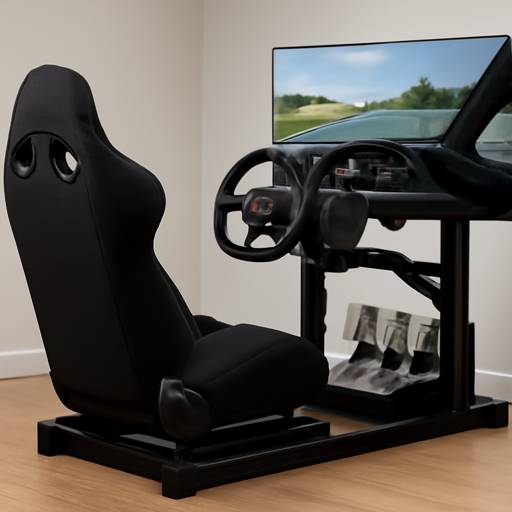
Display choices affect immersion and performance. Triples with tight bezels and a 45–60° wrap can provide the best spatial cues for depth and peripheral flow; a solid SIMGASM monitor stand—hard-coupled to the cockpit—preserves that illusion during heavy curb strikes. Ultrawide singles are simpler and work well in compact spaces. VR unlocks total field of view but benefits from a rig that stays put so the brain maps motion consistently. For small apartments, a shorter footprint chassis with rigid seat sliders can deliver both precise fit and quick stow, while rubber isolation feet tame vibration transfer to the floor.
Personalization is more than paint. Colored accent panels, tactile transducers tuned for RPM, road texture, and gearshift thumps, and seat choices—from tight-laced buckets to cushioned recliners—make the cockpit feel truly owned. Explore a SIMGASM sim racing setup that mirrors driving style: stiffer profiles and high mounts for endurance brakers; faster seat-to-pedal swaps for households sharing the same rig; or modular arms ready for future motion upgrades. When the hardware reflects the driver’s style, confidence rises—and lap time follows.
Tuning the Signal: Software, Calibration, and Maintenance for Repeatable Speed
Even the strongest chassis won’t shine without thoughtful software and calibration. Start by defining the force feedback “budget.” Set maximum wheel torque below injury thresholds but high enough to avoid frequent clipping. In driver software, cull the mush: reduce unnecessary filtering that erases fine detail, but apply enough smoothing to eliminate oscillation and mitigate grain in poorly modeled surfaces. In-game, match the per-car gain and minimum force to maintain a linear relationship from light tire scrub to peak cornering forces. A clean SIMGASM platform makes these small differences audible in the hands—subtleties that guide earlier rotation or throttle commit.
Use a methodical approach. Baseline with a linear profile, then make one change at a time: damping, friction, inertia, recon/filter order, slew rate limits. Each adjustment shifts what the driver feels right as the tire slips across the traction circle. Too much damping can delay countersteer; too little allows chatter and self-oscillation. A good litmus test is a series of fast chicanes and heavy-trail braking zones. If hands can place the car confidently and recover from tiny over-rotations without hunting, the stack is close to optimal. Save profiles per car class; GT3 needs a different envelope than vintage open-wheel.
Pedal setup is equally critical. Calibrate load-cell brakes to match strength and style: a firmer, shorter throw encourages hard, consistent trail; a softer curve can help with endurance stints or street tires. Map a non-linear response so the first 30–40% provides resolution for light scrubbing, while the final 20% holds stiff for threshold braking. Throttle deadzone should be near zero on a rigid pedal deck; add small smoothing only if wheelspin management becomes twitchy. For clutches, tune bite point and hysteresis to the sim’s drivetrain model so launches and downshifts become repeatable rather than theatrical.
Maintenance keeps performance locked. After initial shakedowns, torque-check high-load fasteners—wheelbase mounts, pedal deck bolts, seat brackets. Aluminum can “settle” under clamp loads; a second pass often uncovers tiny slack points that become creaks or microflex later. Inspect for any play in shifter/handbrake pivots, retighten monitor mount clamps, and re-level triples so horizon lines remain true. Dust filters in PCs, verify GPU/CPU temps under race loads, and update firmware only after backing up stable profiles. Treat the rig like a real car: log changes, track lap-time deltas, and correlate feel with telemetry overlays. When everything is stable—chassis, software, and driver routine—consistency tightens. Many drivers see not just raw lap gains but a reduction in standard deviation across long runs, the hallmark of a setup ready for league racing or endurance splits.
A real-world example underscores the payoff. A driver moving from a flexible starter stand to a stiff SIMGASM cockpit with proper pedal bracing re-tuned force feedback to a slightly lower overall gain but higher detail in the midrange. Pedal calibration emphasized a firmer final 20% brake. Over a week of practice, average lap time dropped by 0.6 seconds, but more importantly, variance shrank by 40%. The car felt calmer in off-camber corners because the steering reported onset slip earlier, and braking points required fewer micro-corrections. That is the essence of a high-fidelity rig: fewer surprises, more habit loops, stronger pace.
When a platform remains stable under pressure, every adjustment sticks. The hands learn faster, the feet press more accurately, and the brain trusts what it feels. That is the difference a purpose-built SIMGASM sim racing setup delivers: a silent partner that disappears—so the car, the track, and the drive take center stage.

Brooklyn-born astrophotographer currently broadcasting from a solar-powered cabin in Patagonia. Rye dissects everything from exoplanet discoveries and blockchain art markets to backcountry coffee science—delivering each piece with the cadence of a late-night FM host. Between deadlines he treks glacier fields with a homemade radio telescope strapped to his backpack, samples regional folk guitars for ambient soundscapes, and keeps a running spreadsheet that ranks meteor showers by emotional impact. His mantra: “The universe is open-source—so share your pull requests.”
0 Comments